Showing posts with label PC Engine. Show all posts

Sunday, 3 January 2016

The History of the PC Engine-Part 2-1990-1996


The Super CD ROM2 made its debut in 1990/91. This very long unit added 4 times the RAM from 64KB to 256KB. This meant that games could have more detailed sprites and more data presented on screen. Gradually, games shifted away from HuCard releases to Super CD releases.


 For users of past hardware such as the original CDROM2, gamers could buy the System Card 3.0, which allowed users  to play the new Super CDROM games. Upgrading was a regular part of the PC Engine experience, and the System Card 3.0 was the first major hardware upgrade that updated the performance of the games via more memory.


HuCards games were still coming out during this era. The early 1990s produced some of the most impressive HuCard releases. A very impressive port of Street Fighter 2 was released in 1993. PC Genjin 3 (Bonk 3) and Bomberman 94' are some other notable late HuCards. The later HuCards are especially impressive as they use the basic PC Engine hardware without any memory expansion. Most of these games are very valuable nowadays.


With all of the add-ons released, NEC felt the need to simplify the growing complexity of the hardware with a single unit. Combining the Super CD-ROM2 and original PC Engine into one unit, the PC Engine Duo was released in September 1991 at a cost of 59, 800 Yen. Two versions of the PC-Engine Duo were released. The PC Engine DUO-R was released in 1993 at just under 40,000 Yen. The final variation of the Duo, the Duo RX, was released in 1994. With the end of production of the Duo RX, the PC Engine would meet its fate by 1995. However, what a life it was.


Hundreds of quality titles were released for the Super CD Rom2 in the early 1990s. Some of the most memorable include Dracula X: Rondo of Blood, The Dynastic Hero, Gate of Thunder, PC Genjin 3 (Bonk 3) and many others. Many of these later releases are extremely valuable today, fetching hundreds of dollars each.


Another attempt to extend the life of the PC Engine was made in the form of the Arcade Card Duo and Arcade Card Pro. The cards expanded the memory of the PC Engine to over 2 MBs. While not a lot of games were released for the Arcade Card, the shooter "Sapphire", a port of Strider, and several Neo Geo fighting game ports were released. Sapphire is the most valuable and expensive Japanese CD release, and is widely regarded as a technical marvel. However, by the time of its release, most Japanese gamers had moved on to the Super Famicom. Sadly, the Arcade Card games never got the attention they deserve and remain cult favourites.

By 1996-97, only a few releases trickled out. NEC had released the successor to the PC Engine in December of 1994. The PC-FX was a massive failure, built on outdated technology that was unable to produce real 3-D games. The PC-FX would struggle and fade into obscurity against the Sony Playstation and Sega Saturn.


The PC Engine had a long life. In an era where most consoles live around 4-5 years, the PC Engine was a viable platform from 1987-1995. Upgrades kept the system competitive and viable, but came at a high price to the consumer. CD-ROM attachments and memory upgrades were not cheap, but the die-hards were willing to pay the price for some great games. As an immensely successful platform in Japan, the PC Engine is remembered fondly by many. It has a rabid collecting scene, and some pieces can fetch into the thousands. For those that love it, the PC Engine is the console that never was in the West. The Turbografx 16 failed to make a significant impact in the West, but in Japan the PC Engine almost dethroned Nintendo's Famicom. Hundreds of more games were released in Japan that never made it to Western shores. Collecting for the PC Engine today is much cheaper than collecting for the Turbografx 16, due to the PC Engine being much more popular and commercially successful.


Thursday, 31 December 2015

Martial Champion-PC Engine Review


A PC Engine port of an obscure Konami arcade fighter, this 1993 release is widely regarded as a fair weak port of the arcade original. Let's take a look and find out if there is any reason to play this game.

Released in the wake of Street Fighter II, it seems like every game company responded to the success of SFII with their own fighter. Konami was fairly late to the game, but responded with Martial Champion for the arcades.


The picture above shows the arcade original. the arcade game ran on Konami's famous "Mystic Warriors" arcade hardware. Huge sprites were characteristic of many arcade games at the time, and the arcade Martial Champion was no exception. Sadly, the PC Engine version really suffers on the graphical front.


The picture above shows the PCE port. Characters are massively downsized for this version, and the graphics are sub-par compared to other Super CD releases on the PC Engine. It is hard to believe that Konami released "Rondo of Blood" the same year, as that game is a graphical powerhouse and a great example of what the PCE could achieve even in the twilight of its life.


Like the majority of other 1990s fighting games, Martial Champion assembles a group of "stereotypes" for each country represented. For example, there is a Saudi Arabian "Arabian Knight" with a Prince of Persia type sword and ceremonial garb. There is a Japanese Kabuki fighter (very similar to Kyoshiro from Samurai Spirits/Shodown). The other 9 characters feel just as uninspired, and Martial Champion fails to stand out from the crowd in terms of characters.


The gameplay in Martial Champion is fairly bland. Some fighters have swords and weapons, and many do not. This does allow for some diversity in terms of gameplay, like a mix of Street Fighter and Samurai Shodown (before it was released I might add). The lack of animation for the sprites make the special moves look pretty bad. The fighting system feels clunky and unfinished, and the game is hardly a joy to play. Each character only has a very limited set of moves, but remember this game was made a time when 2-3 moves per character were standard.


Martial Champion allows for a few different modes of play. Tournament mode involves the player fighting his/her way up to the final boss by defeating other computer-controlled characters. If you are lucky enough to have a multi-tap, "vs battle" allows the player to face off against another human-controlled player. The only interesting mode is "group match". You can select different characters to take control of, rather than just picking on character.

One advantage of the game is the stellar music. "Redbook" audio sounds great, and its a shame that such great tracks accompany such mediocre gameplay.

Martial Champion is a game only for 1990s fighting game enthusiasts (I am one of them, I'll play them so you don't have to). Bland gameplay and characters make for an experience that is forgettable.  You would be much better off using MAME to emulate the much-better arcade original than tracking down this one. At 50-70$, the game is also very expensive. Perhaps this is due to the rabid Konami fan-base buying every Konami game ever made. In any case, skip this one.

+Great sounding Redbook audio tracks
+Group match mode is unique

-Poor graphics and sprites
-Bland characters and gameplay
-Expensive to import a copy

Rating-6/10

Tuesday, 29 December 2015

Castlevania/Dracula X-Rondo of Blood-Review


Few games are as legendary as this one. Released just before Halloween in 1993, Rondo of Blood is considered by many to be second only to 1997's "Symphony of the Night" in terms of critical acclaim. However, far fewer have played this gem as it has only officially been released on the PC Engine Super CD, in addition to the Wii Virtual Console. This review will cover the original Japanese 1993 PC Engine CD release.


A long "anime" introduction sets up the story. Once again, a Belmont(Richter) must face off against the evil Dracula. The introduction looks and sounds great. A few more of these cut-scences appear throughout the game and add a lot to the story. However, they are in Japanese. The Wii version does translate the text into English.


On to the gameplay. The game plays and looks like a dream. For a PC Engine game, the sprites are highly detailed and some of the bosses/monsters have huge sprites. The backgrounds are great-looking, and in the first stage you visit the familiar first town from Castlevania II. Deep purples and dark colours fill the sprite palettes, and the game have a wonder ambience of macabre to it.


Like Castlevania 3, Rondo of Blood has branching paths. In this alternate path, you can take control of "Maria". More nimble and agile, Maria plays quite different from Richter, who is more lumbering. Familiar weapons such as the Holy Water and Cross make their return. Many have complained that about Richter's inability to whip multi-directionally, like in Super Castlevania IV. While this is a minor issue, besides CIV, none of the earlier games allowed for this feature either.


Despite the two distinct paths and the ability to play as Maria, Rondo will certainly feel short compared to more modern Vania games. Each play through should take a couple of hours (depending on how many times you die). While this may seem short, each moment is an enjoyable one. Remember, this is before "Metroid-vania" entered our lexicons. Rondo of Blood is a masterpiece, and it deserves to be played by anyone with even a casual interest in the series.

+One of the greatest looking games of its time.
+Plays wonderfully with classic Castlevania gameplay
+Multiple paths and characters


-Somewhat short
-Very expensive to buy a real copy (200+)
-Cutscenes are in Japanese

Rating: 9.5/10

Ryuko no Ken (Art of Fighting)-PC Engine Arcade CD Review


Ever wonder what an 8-bit version of Art of Fighting would look like? Well, look no further than Ryuko no Ken for the PC Engine.  Released in 1994, this late PC Engine release required NEC's expensive "Arcade Card" to run. So, to play this release, you not only need a PC Engine/PC Engine Duo with a CD-ROM attachment, you also need the Arcade Card Duo or Arcade Card Pro. These cards are not easy to come by nowadays, and can run over $70-100 depending on the model.  Sounds like a hassle to play? Only for the die-hards?  Exactly......

Assuming you have managed to track down the expensive Arcade Card you need, let's dive in. After a beautifully animated intro (very close to the Neo Geo original), you will encounter a screen you will become all too familiar with. A loading screen.....


The screen above will drive you nuts. Load times for each match are about 1 minute. Now, remember this is the early 90s. However, other fighters on the PC Engine usually have load times of about 20-30 seconds. I assume this is due to the large amount of memory needed for such large sprites. In any case, they are long. I don't think they ruin the game, but they are quite annoying.


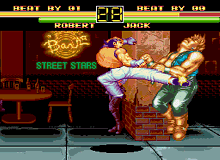
Once the game gets going.....you realize the load times were worth it. Huge sprites (not as big as the Neo Geo), a great CD soundtrack, and solid play mechanics make it a great trip down memory lane. I would recommend getting a six-button controller, as the two-button PC Engine layout can certainly be frustrating. However, I made due with just the two buttons.


The game is not without some other flaws. For fans of modern fighters, this game is very dated. You are only allowed to choose two characters in the main story mode (Ryo and Robert). However, you can play as the other characters in vs. mode. Second, you have a "special move" bar that must recharge in order to unleash fireballs, etc. This is certainly annoying, but it is a quirk I have always found slightly charming in AOF. The game is also quite hard. Seriously, good luck beating Jack the first time.


A specific quirk of this version of the game is its fake "scaling" effect. Like the Neo Geo version, the game attempts to zoom in and out the closer or further you get from an opponent. Despite this attempt , the PC Engine hardware doesn't not really allow for the complex scaling of the NEO GEO. This results is a faux zoom effect. I did not find it as jarring as some have complained, but it might distract some.

In conclusion, Art of Fighting on the PC Engine is only for the hardcore. The Neo Geo version appears on countless SNK compilations, the Wii Virtual console, and in many other forms. There is a somewhat decent SNES/Super Famicom version out there as well. I would stay away from the Genesis/Megadrive version due to its horrible music and tiny sprites. Is this the best home version of AOF outside of the Neo Geo? Yes! Does it cost an arm and leg to get? Yes! You not only need an expensive PC Engine Duo or CD Rom, you need the Arcade Card. However, if you have these things, or have an emulator that can run this format, give it a shot. It is a curiosity from a long-gone era of 2D fighters, but a fairly great port for a machine that debuted in Japan in 1987.

+ Great-looking sprites.
+Fantastic CD Soundtrack
+Plays great

-Need a lot of hardware and Arcade Card to play
-Two-button layout is somewhat clumsy
-Long load times

Score: 7.8/10