Showing posts with label snk. Show all posts

Tuesday, 5 January 2016

Takara: Masters of the Port Part 1: 1992-1995-JGC Feature

The name Takara is near-synonymous with fighting games. Anyone playing fighters during the 16-bit era likely came across some of their games for the Genesis/Mega Drive or Super Famicom/SNES. Many of these ports were faithful versions of the original games. Many were sub-par ports that were vastly inferior to their Neo Geo counterparts. Japan Game Cave will take a look at some of their best and worst ports from the Neo Geo.

A little bit of background is needed before jumping into Takara's ports. The Neo Geo MVS was released in 1990 and soon made waves across the globe.  An international arcade smash, the technically gifted Neo Geo would soon make its way home in the form of the Neo Geo AES console. Far too expensive for the average consumer, companies began to look for other ways to get the games into the average family living room. Takara would seek to fill that void.

Founded in 1955, Takara would be a major player in the Japanese toy market. Their most successful product would be the creation of the "Transformers". Today, the Transformers empire is valued in the millions. Despite their success in the toy industry, Takara became involved in the growing home video game market in the 1980s. In the 1990s, their main focus would shift to porting Neo Geo games to various platforms.


Released in 1991. King of the Monsters was a fairly successful arcade game at the game. Players take control of giant monsters and battle it out in large city-scapes. Takara ported the game to the Super Famicom and later the SNES. The Super Famicom version features obviously scaled-down sprites and backgrounds, far less detailed than the huge sprites of the Neo Geo original. The game would also make it to the Mega Drive/Genesis in 1993. The game looks arguably worse on the Genesis, with less colours and detail in the backgrounds.

King of the Monsters 2 would also make it to both the SFC/SNES and Genesis/MD. Many say that the sequels are better for both systems, but most give the Nintendo console a slight edge due to the more colourful visuals and better sound. You choose. In any case, it can be argued that despite weaker visuals, King of the Monsters 1 and 2 made it home mostly intact.


Garou Densetsu (Fatal Fury in the West) is one of
SNK's most beloved franchises. Released into arcades in 1991, the Neo Geo original was one of the first major fighting games to challenge Street Fighter 2 and its dominance. The game would come home to the SFC in 1992. Like King of the Monsters, Garou Densetsu would take a graphical hit coming home. Sprites are again noticeably less detailed than the Neo Geo. However, like most SFC/SNES games, the sound is quite good, making effective use of the SFC's sound capabilities. The Mega Drive/Genesis version was not quite as faithful as on the Nintendo console. Murky background and tinny sound would mar the port of GD on the Sega console. Most prefer the SFC/SNES port to the Genesis/MD.

Garou Densetsu 2 (Fatal Fury 2) was released in 1992 in the arcades. Vastly expanding the character rooster (you could only play as three characters in the 1-player mode of the original), the game was another success for SNK. The SFC is quite faithful the Neo Geo original in this author's opinion. Vivid colours, great controls, and excellent sound make the SFC/SNES port as close as one could with a 16-bit console. As for the MD/Genesis port, many argue that it plays faster and better due to the "blast processing" on Sega's hardware. I believe that the Sega version does not look as good or sound as good, but this is certainly up for debate. What is clear, Takara produced quality ports of Garou Densetsu 2 for both 16-bit consoles. Much better than the first Garou game. Garou Densetsu Special, an expanded version of Garou 2 would make it home to the SFC/SNES, but failed to make it Sega's console.


I have never played this version of the game, but have heard great things about it. Takara also released portable versions of Fatal Fury. A Gameboy port of Fatal Fury 2 was released in 1994. Also, a Sega Gamegear port was released in 1993. Many criticize the portable ports as mere cash-ins, having little value. I have not played either portable Takara games.

Another one of SNK's major franchises was Ryuuko no ken. Known as Art of Fighting in the West, the series became famous for its massive sprites and scrolling backgrounds. Released in 1992, the game would find its way home for all of the 16-bit consoles (and even the PC Engine). With sprites this huge, sacrifices were going to be made. Both versions of this game suffered coming home. The scrolling was omitted in the Genesis/MD version, and the sound and music are generally quite poor. In the SFC/SNES version, the scrolling remains, but is vastly subdued compared to the Neo Geo. Character sprites look almost as bad as on the Sega console.


Ryuuko no ken 2 would come home only to the Super Famicom, and only in Japan. Many regard the sequel as a much better port. Characters looks better animated and detailed but still pale in comparison to the Neo Geo original. Developed by arcade developer Saurus, it is one of the best SFC fighters. The game was actually ported outside of Takara's oversight, and many consider that the reason why it was vastly superior than most of Takara's 16-bit ports. World Heroes would find its way home to the 16-bit consoles, but this porting was done by Saurus, Sunset, and Mid-West with mixed results.


After the massive arcade success of Samurai Spirits (Samurai Shodown in the West) in 1993, Takara would bring the game home to the Super Famicom and Mega Drive. Vastly inferior ports would also find their way to the Gameboy and Gamegear. While the SFC took the advantage for most 16-bit Takara games, the SFC is a pile of garbage. Yes, it keeps all characters including Earthquake (he has a massive sprite in the arcade version), but it just plain insults the original game. Characters are reduced to a microscopic size and backgrounds look flat and dull. The sound is ok, but nothing special. The Genesis/MD version has much bigger characters, but omits Earthquake entirely from the game. I would rather omit a character than shrink the game. The SFC/SNES port has to be one of the worst atrocities that Takara committed during the 16-bit era.


The legacy of Takara has to be understood within the technical constraints of the day. Arcade hardware such as the Neo Geo was much more technically powerful than home consoles hardware. Takara ports are a mixed bag to say the least, some decent and close, others are completely off the mark. They are strange curiosities today. There are dozens of ways to play the Neo Geo originals, and they are always vastly superior to Takara ports. Takara brought home some of the biggest games of the day for kids like me who didn't have a Neo Geo at home, and for that, they do have a special place in my heart. Takara would not finish their ports with the 16-bit era, more would come.......to be continued in part 2......

Tuesday, 29 December 2015

Ryuko no Ken (Art of Fighting)-PC Engine Arcade CD Review


Ever wonder what an 8-bit version of Art of Fighting would look like? Well, look no further than Ryuko no Ken for the PC Engine.  Released in 1994, this late PC Engine release required NEC's expensive "Arcade Card" to run. So, to play this release, you not only need a PC Engine/PC Engine Duo with a CD-ROM attachment, you also need the Arcade Card Duo or Arcade Card Pro. These cards are not easy to come by nowadays, and can run over $70-100 depending on the model.  Sounds like a hassle to play? Only for the die-hards?  Exactly......

Assuming you have managed to track down the expensive Arcade Card you need, let's dive in. After a beautifully animated intro (very close to the Neo Geo original), you will encounter a screen you will become all too familiar with. A loading screen.....


The screen above will drive you nuts. Load times for each match are about 1 minute. Now, remember this is the early 90s. However, other fighters on the PC Engine usually have load times of about 20-30 seconds. I assume this is due to the large amount of memory needed for such large sprites. In any case, they are long. I don't think they ruin the game, but they are quite annoying.


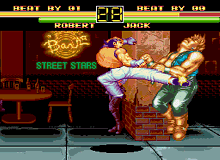
Once the game gets going.....you realize the load times were worth it. Huge sprites (not as big as the Neo Geo), a great CD soundtrack, and solid play mechanics make it a great trip down memory lane. I would recommend getting a six-button controller, as the two-button PC Engine layout can certainly be frustrating. However, I made due with just the two buttons.


The game is not without some other flaws. For fans of modern fighters, this game is very dated. You are only allowed to choose two characters in the main story mode (Ryo and Robert). However, you can play as the other characters in vs. mode. Second, you have a "special move" bar that must recharge in order to unleash fireballs, etc. This is certainly annoying, but it is a quirk I have always found slightly charming in AOF. The game is also quite hard. Seriously, good luck beating Jack the first time.


A specific quirk of this version of the game is its fake "scaling" effect. Like the Neo Geo version, the game attempts to zoom in and out the closer or further you get from an opponent. Despite this attempt , the PC Engine hardware doesn't not really allow for the complex scaling of the NEO GEO. This results is a faux zoom effect. I did not find it as jarring as some have complained, but it might distract some.

In conclusion, Art of Fighting on the PC Engine is only for the hardcore. The Neo Geo version appears on countless SNK compilations, the Wii Virtual console, and in many other forms. There is a somewhat decent SNES/Super Famicom version out there as well. I would stay away from the Genesis/Megadrive version due to its horrible music and tiny sprites. Is this the best home version of AOF outside of the Neo Geo? Yes! Does it cost an arm and leg to get? Yes! You not only need an expensive PC Engine Duo or CD Rom, you need the Arcade Card. However, if you have these things, or have an emulator that can run this format, give it a shot. It is a curiosity from a long-gone era of 2D fighters, but a fairly great port for a machine that debuted in Japan in 1987.

+ Great-looking sprites.
+Fantastic CD Soundtrack
+Plays great

-Need a lot of hardware and Arcade Card to play
-Two-button layout is somewhat clumsy
-Long load times

Score: 7.8/10